Underwriting Without the Credit Bureau: Small Models, Then Agents
How industry-specific models and a multi-agent review replaced a dependency on bureau credit scores for B2B buyer risk, and where each approach belongs.
Case study, 2026. AI product lead at a B2B financing platform.
- Role
- AI product lead. Designed the risk models and the agent architecture, working with finance and risk leadership.
- Context
- A B2B financing platform deciding whether business buyers can repay.
- Approach
- Industry-specific, explainable models first. A multi-agent review only where context changes what the data means.
- Note
- Company, customer and data details are generalized. Figures are the ones I'm able to share.
00
The problem
The platform used a major credit bureau’s score to decide which business buyers could repay. For this market it was unreliable. On our own repayment data it performed little better than chance (an AUC of about 0.50), so it approved buyers who later went delinquent and gave little signal on the ones who wouldn’t.
A general-purpose score is built for every borrower at once. Our buyers were businesses in a handful of specific industries, and we had something the bureau didn’t: our own record of how those buyers actually paid.
01
One model per industry
I trained custom machine-learning models on the platform’s payment history and buyer delinquencies, then investigated both internal and external signals to find what predicted a buyer’s ability to repay.
The key finding: the signals that matter differ by industry. A signal that strongly predicts repayment in one industry can be noise in another. One blended model averages those differences away, so I built industry-specific models instead.
- Deterministic and weighted. Each model is a weighted, explainable scoring model, so every score can be traced to the signals behind it. That matters for underwriters, for customers and for anyone auditing a decline.
- Internal plus alternative data. Payment behavior on the platform, combined with external and alternative data sources, in place of a single bureau number.
02
Testing the bureau score
The obvious question was whether to keep the bureau score as one input among many. I tested the models with and without it.
With the internal and alternative data in place, adding the bureau score barely changed the results. The models performed just as well without it. That turned the bureau from a dependency into an optional input, with the cost and reliance that came with it.
03
A model that re-ranks itself
The models were backtested against historical outcomes before going live. Once live, they re-rank automatically based on each quarter’s repayment performance, so the weights follow what is actually happening rather than what happened when the model was trained.
Results against the bureau-based approach:
- AUC rose from 0.50 to 0.65.
- 20–50% more delinquencies were flagged, including clear declines the previous approach had missed.
04
Where deterministic models stop
Some risk doesn’t fit a weighted score, because the same data can mean different things depending on the business. A lawsuit, a funding round or a fast hiring curve can be a good sign for one company and a warning for another, depending on its size, industry and stage. Conditions also keep changing, so a fixed rule written today can be wrong next quarter.
These are the cases a human underwriter handles with a manual review: read everything relevant, weigh it against the company’s situation, and make a judgment. That is the part I gave to agents.
05
The underwriting review agent
I designed a multi-agent system that acts as a manual underwriting review:
- Four sub-agents with research tools, coordinated to investigate a buyer from different angles.
- A credit-review skill that encodes how an underwriter works through a file: what to look for, and how to weigh it for a company of a given size, industry and stage.
- Research, not fixed retrieval. Instead of pulling a predefined set of fields, the agents follow leads one to four degrees out from the buyer, because which information is relevant depends on what they find.
- Signals with sources. The output surfaces the signals that drove the recommendation, so an underwriter can check the reasoning rather than trust a number.
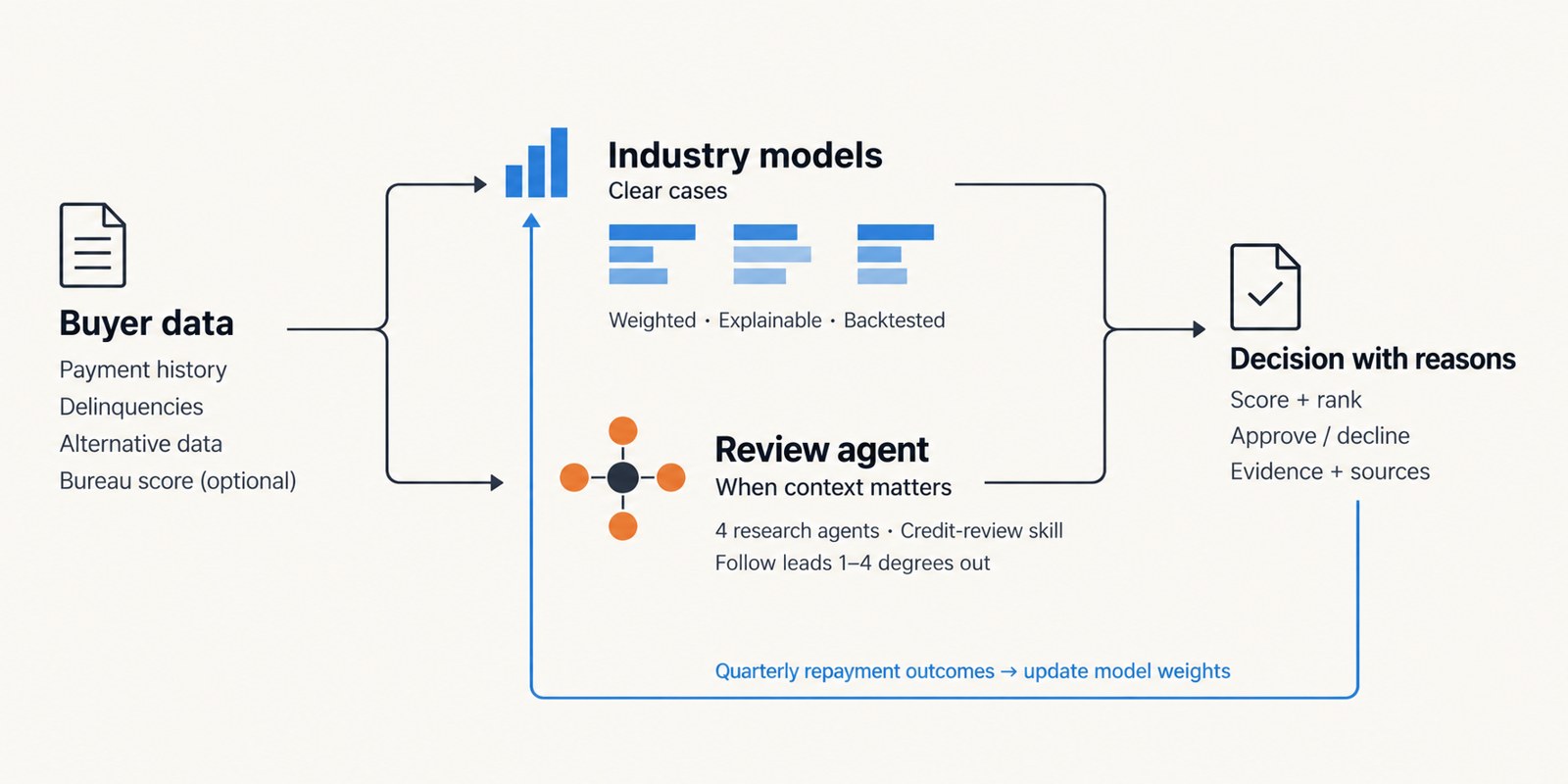
The agent layer doesn’t replace the models. The models handle volume and the clear cases consistently and cheaply. The agents handle the cases where context decides.
06
A decline the score missed
One case showed the difference clearly. A well-funded, fast-growing, venture-backed company applied, and the scoring model rated it a good risk.
The review agent flagged it for decline. It had read the company’s open legal cases and their current status, compared that exposure with the company’s growth and funding, and concluded that the litigation risk was too high, even for a company of that size and growth rate.
About a month later, the company publicly filed for bankruptcy.
The scoring model wasn’t wrong about the data it saw. The data just didn’t capture what the legal filings meant for this particular company. That kind of judgment needs context, and that is where agents earn their place.
07